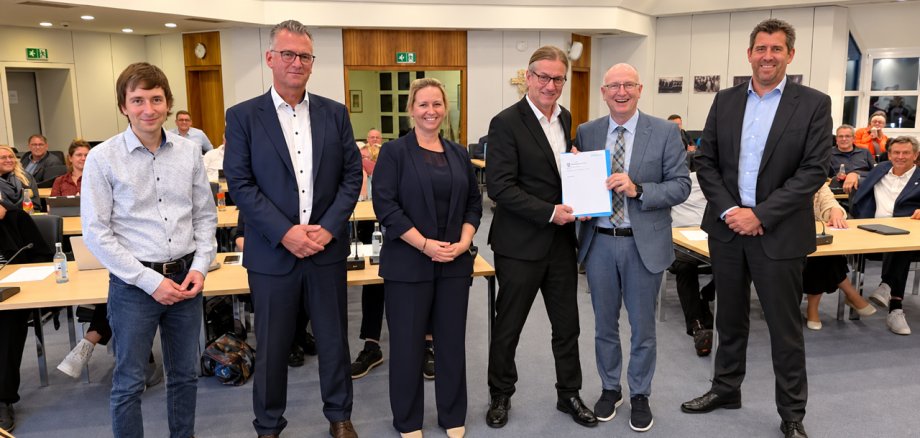
The North Rhine-Westphalia Municipal Audit Office (gpaNRW) has been auditing the pilgrimage town of Kevelaer over the past few months as part of its regular regional audit. The audit focused on finances, payment processing and enforcement, committee work, personnel, organization and information technology, climate protection, and municipal crisis management. The findings and recommendations were presented to the City Council on Thursday by auditor Stefanie Köster, auditor Tobias Fuß, project manager Mario Deckers, and Michael Esken, president of the gpaNRW. They are intended to help the pilgrimage town of Kevelaer continue to fulfill its responsibilities in a cost-effective, legally compliant, and efficient manner.
The budget situation calls for consolidation measures
The gpaNRW sees an urgent need for action regarding the budget situation in the pilgrimage town of Kevelaer. While the town was still able to post positive annual results from 2019 to 2022, it reported deficits in 2023 and 2024. The budget projections through 2029 also anticipate deficits.
Although the city’s equity base was still above average compared to other municipalities in 2024, the projected budget shortfalls would completely deplete the equalization reserve and nearly completely deplete the general reserve. Consequently, the 2026 budget required the development of a budget stabilization plan. “The gpaNRW sees an urgent need for the pilgrimage town of Kevelaer to improve its budget situation through consolidation measures,” explains Michael Esken, president of the gpaNRW.
Further Strengthen Profitability and Credit Management
For larger investments, gpaNRW recommends establishing binding thresholds for feasibility studies and systematically taking follow-up costs into account. Supplementary guidelines could assist the departments in making investment decisions.
gpaNRW also sees opportunities for improvement in credit management. Written policies and interim reporting could further enhance transparency and legal certainty.
Efficiently Organized Payment Processing, Enforcement, and Committee Work
According to gpaNRW’s assessment, payment processing and collection are handled in a cost-effective manner. There is room for improvement regarding the proportion of payments made via the SEPA Direct Debit scheme. The pilgrimage town of Kevelaer should communicate the benefits of this system more effectively and continue to encourage its use.
The gpaNRW also rates the committee structure of the pilgrimage town of Kevelaer as unremarkable. Compared to other municipalities, significantly fewer meetings were held during the period under review. “This points to efficient and forward-looking meeting management,” said auditor Tobias Fuß. The digital council information system and full compliance with disclosure requirements under the Anti-Corruption Act were also highlighted as positive aspects.
Strong Foundation in Terms of Workforce and Digitalization
In the area of human resources, organization, and information technology, the pilgrimage town of Kevelaer is generally well-positioned compared to other municipalities. In the area of human resources, numerous structured procedures are already in place to ensure the town’s long-term operational capacity.
In the area of organization, the administration uses tools for, among other things, staff replacement, position evaluations, and project-related process reviews. However, gpaNRW recommends creating a uniform, administration-wide framework for prioritizing tasks, setting quality goals, and systematically documenting and further developing processes. “There is still significant room for improvement, particularly in process management,” said auditor Stefanie Köster.
According to gpaNRW, the pilgrimage town of Kevelaer is exceptionally well-positioned in the areas of information technology and digitalization. In particular, more measures have already been implemented regarding the use of artificial intelligence than in many comparable municipalities. The gpaNRW sees further potential in standardizing project management within IT service management.
Keeping an Eye on Climate Protection Goals and the Building Stock
The pilgrimage town of Kevelaer has had an integrated climate protection plan in place since 2016 and is currently having a climate adaptation plan developed. According to gpaNRW, the goal of achieving citywide greenhouse gas neutrality by 2045 requires a review and update of the existing action plan, particularly with regard to the city’s building stock.
Project Manager Mario Deckers explains: “According to gpaNRW’s assessment, the city would need to double its funding for its own building stock in the long term if it wants to achieve its goal of a GHG-neutral building stock by 2045.”
Crisis management is viewed positively
The gpaNRW also gives a positive assessment of municipal crisis management. The pilgrimage town of Kevelaer has analyzed, assessed, and prioritized risks, and has developed scenario-based action plans for the most critical risks. The staff designated for the Emergency Response Team are being trained; in addition, drills are held regularly, sometimes in collaboration with other municipalities. Lessons learned from operations and drills are systematically evaluated and used to further develop crisis management. “This strengthens and solidifies the operational capabilities of the deployed staff and enables the development of operational routines,” said auditor Tobias Fuß.
Mayor Dr. Dominik Pichler commented on the results of the gpaNRW audit: “The audit confirms that we are doing good, forward-looking work in many areas. At the same time, it makes it clear that we must monitor the development of our budget with great diligence. Continuing to implement the budget stabilization plan is a challenging task that policymakers and administrators will once again tackle responsibly together during this year’s budget deliberations. The recommendations from gpaNRW provide us with a solid framework for further developing existing structures, setting necessary priorities, and securing the long-term viability of the pilgrimage town of Kevelaer.”
Information about gpaNRW and the exam
The gpaNRW conducts regular audits of municipalities in North Rhine-Westphalia. In Kevelaer, the audit covered the areas of finance, payment processing and collection, committee work, human resources, organization and information technology, facilities management and climate protection, as well as municipal crisis management.
The full audit report, including all findings and recommendations, will be published shortly by gpaNRW at www.gpa.nrw.de.
gpaNRW is part of the state audit office of North Rhine-Westphalia and conducts regional audits of municipalities, counties, and other local government bodies. It is headquartered in Herne.