
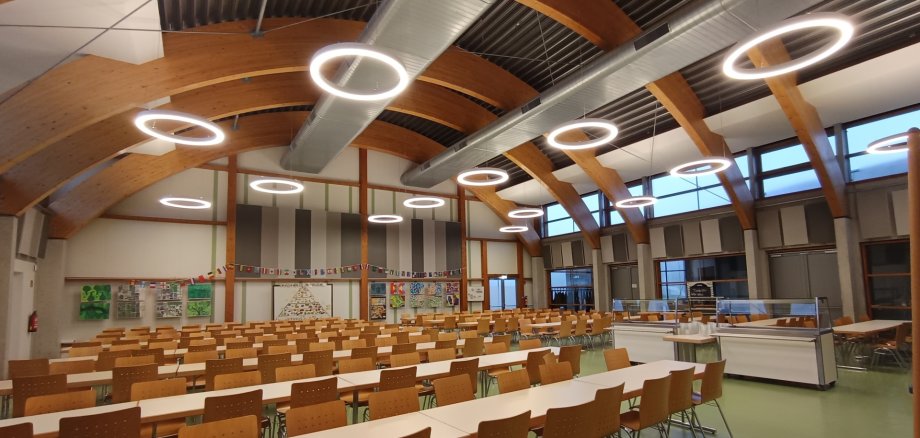
In October 2026, the lighting system in the cafeteria in Kevelaer was replaced. A total of 15 new pendant ring lights with a diameter of 120 centimeters were installed. The upgrade is part of the modernization of the building’s technical systems and ensures that the space is lit in a contemporary, pleasant, and needs-based manner.
The old lights had to be replaced because they were damaged after more than 14 years of use. The light fixture mounts had become porous due to age-related material fatigue. Since replacement parts were no longer available for the existing lights, the pilgrimage town of Kevelaer decided to completely replace the lighting system.
The new LED fixtures emit light directly downward as well as indirectly upward. This illuminates the usable space in the cafeteria, and—with a ceiling height of 9 meters and a fixture mounting height of 6 meters—the ceiling is incorporated into the light distribution. In addition, the indirect light highlights the architecture of the cafeteria’s barrel vault ceiling. The total cost for the purchase and installation of the system amounts to approximately 40,000 euros.
Energy and Cost Savings
The switch to LED technology reduced the lighting system’s connected load from the original 5,120 watts to 1,050 watts. Assuming the system operates 200 days per year for seven hours a day, this results in electricity savings of approximately 5,700 kilowatt-hours per year. This corresponds to a reduction in electricity consumption of about 80 percent. At an electricity price of 32 cents per kilowatt-hour, annual energy costs are reduced by approximately 1,823 euros. CO₂ emissions are reduced by approximately 2 metric tons per year. Over an assumed service life of 25 years, the calculated savings total approximately 142,450 kilowatt-hours of electricity, 45,600 euros in energy costs, and 49 metric tons of CO₂.
Originally, 85,000 euros had been budgeted for the new cafeteria lights. Due to the city’s tight budget situation, the necessity of this measure was questioned on several occasions.
The facilities management team had already received the first bids by 2025. Instead of hiring an external engineering firm to handle the bidding process as originally planned, the facilities management team ultimately took on the research, planning, and bidding process itself—and was thereby able to cut costs by more than half.
“With this lighting upgrade, we are combining modern and appealing interior design with sustainable energy use,” said Mayor Dr. Dominik Pichler. “This initiative is another step in the ongoing modernization of municipal buildings and demonstrates how improved quality of life and climate protection can be meaningfully combined.”
Key figures on the new cafeteria lighting at a glance:
- Quantity & Type: 15 pendant ring lights (LED)
- Diameter: 120 cm
- Power per light fixture: 70 watts
- Luminous flux: 7,100 lumens
- Color temperature: 3,000 Kelvin (warm white)
- Energy savings: approx. 5,700 kWh per year (~80%)
- Energy cost savings: approx. 1,823 € per year (assumed electricity price: 32 cents/kWh)
- CO₂ savings: approximately 2 metric tons per year
- Total savings (over 25 years): ~142,450 kWh of electricity, ~45,600 € in energy costs, and 49 metric tons of CO₂
- Investment costs: approximately 40,000 euros: 25,000 euros for lighting fixtures + 10,000 euros for electrical work + 5,000 euros for scaffolding, work platforms, protective flooring, and ancillary work